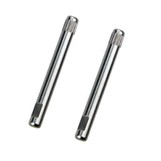
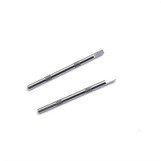
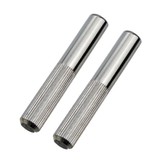
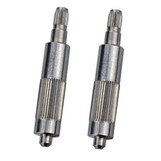
Precision Solid Shaft
Product Introduction
Precision solid shaft is a high coaxiality, high rigidity stainless steel or alloy shaft, which is CNC machined and finely ground, and is widely used in industrial occasions such as precision transmission, rotary positioning, etc.
Product Features
High-precision Manufacturing
Precision solid shaft is processed by CNC, with a diameter tolerance of ±0.003mm and a straightness of ≤0.05mm/m. It can achieve high positioning accuracy and gapless operation with guide rails or bearings.
Smooth Surface
The surface of the precision solid shaft is Ra≤0.4μm. After mirror grinding or polishing, friction and wear are greatly reduced, which is suitable for high-frequency reciprocating motion occasions, such as linear modules.
Strong Corrosion Resistance
The precision solid shaft is made of 304/316 stainless steel or treated with an oxide coating, which can run stably for more than 8 years without rust in high humidity and high salt environments.
Product Application
Industrial Robotics
In industrial robots, precision solid shafts are mainly used for the connection and transmission of joints.
Precision Instruments
For precision instruments such as three-coordinate measuring machines, the solid shaft is used to support and drive the measuring parts.
Automobile Manufacturing
The crankshaft of a car engine is a typical precision solid shaft. When the engine is working, it converts the reciprocating linear motion of the piston into its own rotational motion, and then outputs power to drive the vehicle.
Cnc Machine Tool
The lead screw of a CNC machine tool often uses a solid shaft. During the machining process of the machine tool, the lead screw is responsible for converting the rotational motion of the motor into the linear motion of the workbench or tool.
Packaging Machinery
In packaging machinery, precision solid shafts are used to drive key components such as conveying devices and sealing devices.


Company Advantages
Shenzhen Sanhexing Shaft Manufacturing Co., Ltd. was established on May 26, 2010, and is located in Wanfeng Technology Park, Shajing, Bao'an District, Shenzhen. Our factory covers an area of 1,600 square meters, and there are developed electronic and mechanical manufacturing supporting industries nearby. We are a private enterprise specializing in the customized production of various precision mechanical hardware components and non-standard precision shafts. We have more than 50 employees, including 15 technical design management personnel and 8 quality control personnel, with strong design development and quality management capabilities.
Rich Products: We specialize in the production of stainless steel motor shafts, stepped shafts, knurled shafts, screw shafts, worm shafts, gear shafts, spindles, and high-precision shaft products.
Wide Range Of Product Applications: The products can be used in automobiles, drones, electrical equipment, industrial robots, electronic appliances, motors, toys and other industries.
Quick Response: We promise to respond to your inquiries within 24 hours to ensure that you receive the information and support you need in a timely manner.
ODM/OEM Service: We can customize and process various special copper and aluminum materials according to drawings or samples. Special shaped precision parts.
Frequently Asked Questions
What is the working principle of precision solid shaft?
Precision solid shaft ensures coaxiality and surface finish through high-precision machining, and transmits torque and motion through rigid structure. Its mating bearing forms a low-friction rotating pair, and the axial and circumferential positioning of components is achieved through structures such as shaft shoulders and keyways to ensure motion accuracy.
What fields are precision solid shafts mainly used in?
Precision solid shafts are widely used in machine tool manufacturing (such as machining center spindles), semiconductor equipment (photolithography table drive shafts), medical equipment (CT machine rotation shafts), aerospace (precision gyroscope shafts), etc., to meet high-precision and high-stability demand scenarios.
What are the installation steps and precautions for precision solid shafts?
First clean the surface of the shaft and mating parts, apply lubricating oil, and use special tooling to lightly press and assemble. Avoid knocking to damage the shaft surface. Check the coaxiality and verticality after installation to ensure smooth rotation and prevent vibration and wear due to improper installation.
How to maintain precision solid shafts to extend their service life?
Regularly clean impurities on the shaft surface and replace grease to prevent foreign matter from entering the mating surface. Monitor the operating temperature and vibration data, and adjust abnormalities in time. Avoid overload operation, apply anti-rust oil and protect with a protective cover when idle for a long time.
How to repair the wear of precision solid shaft?
Minor wear can be restored by polishing and grinding; moderate wear can be processed by laser cladding technology, depositing wear-resistant materials and then processing; severe wear requires replacement of new shafts, and the repair process requires strict control of size and shape tolerances.
What is the performance difference between precision solid shafts and hollow shafts?
Solid shafts have strong rigidity and high torque load, but large mass; hollow shafts have light mass and small moment of inertia, which is conducive to high-speed rotation. Solid shafts are suitable for heavy-load and low-speed scenarios, and hollow shafts are mostly used in automation equipment with high dynamic response requirements.
How to prevent vibration of precision solid shafts when running at high speed?
Eliminate eccentric mass through dynamic balancing correction, optimize bearing selection and installation preload, and design a reasonable shaft system structure to reduce resonance. Use damping materials or vibration reduction devices to absorb vibration energy to ensure high-speed operation stability.
What are the surface treatment methods for precision solid shafts?
Common methods include quenching to improve surface hardness, hard chrome plating to enhance wear resistance and corrosion resistance, and nitriding to form a dense hardened layer. Blackening treatment can also be used to prevent rust, or ceramic coating can be sprayed to improve surface performance.
How to clean and select cleaning agents for precision solid shafts?
First wipe the surface dust with a dust-free cloth, and then use a special cleaning agent (such as a neutral solvent) to remove oil stains. Avoid using corrosive cleaning agents, and blow dry with clean compressed air after cleaning to prevent residual liquid from corroding the shaft surface.
How to determine the matching method between precision solid shafts and bearings?
Select matching tolerances based on load type, speed, temperature and other factors. Clearance fit is selected for light load and high speed to facilitate installation and heat dissipation; interference fit is selected for heavy load and low speed to ensure stable connection; transition fit is used in occasions with high positioning requirements.
Hot Tags: precision solid shaft, China precision solid shaft manufacturers, suppliers, factory, Precision Fixed Shaft, solid shaft, knurled shaft, Robot Main Shaft, Stainless Steel Drive Shaft, rotating shaft