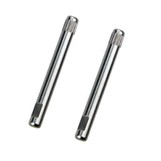
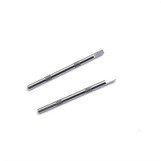
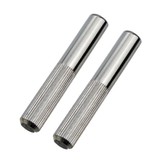
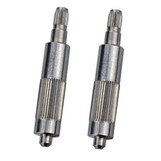
Stainless Steel Spline Shaft
Key Features of Spline Shaft
High Torque Transmission Capability:
The toothed structure of the spline shaft provides higher torque transmission capabilities than cylindrical shafts or keyways. The splines effectively transfer power between components while minimizing sliding friction and wear.
High Precision and Stability:
Spline shafts are typically manufactured with high precision, ensuring that the spline teeth perfectly match the mating components. This precision ensures stable and efficient torque transmission, making it ideal for high-speed and high-load applications.
Fatigue Resistance and Durability:
The spline shaft's tooth design allows it to handle higher working loads and provides greater resistance to fatigue. This means that the spline shaft remains operational for a longer period without failure due to excessive wear.
Adaptation to High Load Conditions:
Spline shafts are designed to operate under heavy loads, vibrations, or impacts. Their strong torque transmission capability ensures stable performance even in extreme working conditions.
Ease of Disassembly and Maintenance:
Because spline shafts rely on tooth profiles for power transmission, disassembly and replacement of mating components are typically easier compared to traditional keyway or cylindrical shafts.
Variety of Spline Designs:
Spline shafts come in different tooth designs, including straight splines (parallel splines), helical splines (spiral splines), and internal/external splines. Each design has unique advantages suited for different torque transmission needs.
Types of Spline Shafts
Straight Spline (Parallel Spline):
Straight splines are the most common type, with teeth arranged in a parallel pattern. They are widely used in mechanical systems for transmitting larger torque, offering a simple structure and lower manufacturing costs.
Helical Spline (Spiral Spline):
Helical splines have teeth arranged in a diagonal or spiral pattern. This design provides smoother power transmission, reducing noise and vibration. It is ideal for high-precision, high-load, and high-speed applications.
Internal and External Spline Shafts:
Internal splines have teeth located within the shaft's inner diameter, while external splines have teeth on the outer surface. These types of spline shafts engage with internal or external mating components, respectively. They are commonly used in drive systems, power transmission devices, and more.
Double Spline Shaft:
A double spline shaft features spline teeth at both ends or multiple positions on the shaft, allowing for power transmission between multiple components. This type is used in more complex drive systems.
Applications of Spline Shafts
Automotive Industry:
In the automotive industry, spline shafts are commonly used in components like transmissions, drive shafts, and steering systems to transmit power. They can handle high loads and provide smooth power transfer.
Industrial Machinery:
Spline shafts are used in machinery such as CNC machines, pumps, fans, and other industrial equipment to ensure reliable and efficient power transmission in mechanical drive systems.
Aerospace:
In aerospace, spline shafts are used in aircraft systems, particularly where high loads and high-speed rotation are required, such as in aircraft engines or spacecraft drive systems.
Agricultural Machinery:
Spline shafts are widely used in agricultural equipment such as tractors and harvesters, providing high torque output for demanding agricultural applications.
Marine and Heavy Equipment:
In the marine and heavy equipment industries, spline shafts are used to handle large torque loads and maintain stable power transmission under harsh conditions.
Automation and Robotics:
Spline shafts are also commonly found in robotics and automation systems, where they serve as crucial components for precise motion and power transfer, ensuring efficient and accurate operation.
Manufacturing and Processing of Spline Shafts
Heat Treatment:
Spline shafts are typically subjected to heat treatment (such as quenching and tempering) to improve hardness and wear resistance, ensuring they maintain performance under high-load conditions.
Precision Machining:
The spline teeth are manufactured using precision machining processes such as spline rolling, broaching, or milling to ensure the required accuracy and surface quality.
Surface Treatment:
To enhance corrosion resistance and extend the lifespan of the spline shaft, surface treatments like galvanizing or chrome plating are often applied.
Why Choose Our Spline Shafts?
ISO 9001 Certified: 100% dimensional inspection via CMM before shipment.
Rapid Prototyping: 5-day lead time for custom spline designs.
Material Flexibility: SUS304/SUS316 for corrosion resistance, SUS440C for high hardness.
Bulk Order Benefits: Volume discounts available for orders over 1,000 pieces.


Hot Tags: stainless steel spline shaft, China stainless steel spline shaft manufacturers, suppliers, factory, electric toothbrush shaft, Precision Drive Shaft, robot shaft, SUS440C Stainless Steel Shaft, Precision Solid Shaft, Stainless Steel Fixed Shaft