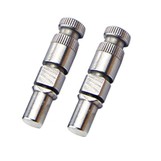
Hey there! As a rotating shaft supplier, I often get asked about dynamic and static balancing of rotating shafts. So, I thought I'd write a blog post to explain these concepts in a way that's easy to understand.
Let's start with the basics. A rotating shaft is a crucial component in many machines, from small household appliances to large industrial equipment. When a shaft rotates, any uneven distribution of mass can cause vibrations, which can lead to premature wear and tear, reduced efficiency, and even failure of the machine. That's where balancing comes in.
Static Balancing
Static balancing is the process of ensuring that the center of gravity of a rotating shaft lies on its axis of rotation. In simpler terms, it means making sure that the shaft doesn't have any heavy spots that would cause it to tilt or wobble when it's at rest.
Imagine a simple shaft with a weight attached to one side. When the shaft is stationary, the weight will cause it to tilt towards that side. This is an example of an unbalanced shaft. To balance it statically, we need to add or remove weight from the shaft until the center of gravity is aligned with the axis of rotation.
There are a few different methods for static balancing. One common method is to use a balancing stand. The shaft is placed on the stand, which allows it to rotate freely. If the shaft is unbalanced, it will naturally come to rest with the heavy side at the bottom. We can then add or remove weight from the shaft until it remains in a neutral position, indicating that it's statically balanced.
Another method is to use a static balancing machine. These machines use sensors to measure the unbalance of the shaft and provide a readout of the amount and location of the imbalance. Based on this information, we can add or remove weight from the shaft to achieve balance.
Static balancing is relatively simple and inexpensive, and it's suitable for many applications where the shaft rotates at low speeds. However, it doesn't take into account the effects of centrifugal force, which can become significant at higher speeds. That's where dynamic balancing comes in.
Dynamic Balancing
Dynamic balancing is the process of ensuring that a rotating shaft is balanced under operating conditions. Unlike static balancing, which only considers the shaft at rest, dynamic balancing takes into account the effects of centrifugal force, which can cause the shaft to bend or deform as it rotates.
When a shaft rotates at high speeds, any unbalance can cause it to vibrate, which can lead to a number of problems. These vibrations can cause excessive noise, reduce the efficiency of the machine, and even damage the bearings and other components. In extreme cases, they can cause the shaft to fail catastrophically.
To achieve dynamic balance, we need to measure the unbalance of the shaft while it's rotating. This is typically done using a dynamic balancing machine, which uses sensors to measure the vibrations of the shaft and provide a readout of the amount and location of the imbalance. Based on this information, we can add or remove weight from the shaft to achieve balance.
Dynamic balancing is more complex and expensive than static balancing, but it's essential for many applications where the shaft rotates at high speeds. It's particularly important for applications where the shaft is subject to high loads or where precision is critical, such as in aerospace, automotive, and medical equipment.
There are a few different types of dynamic balancing machines, each with its own advantages and disadvantages. Some machines use a single-plane balancing method, which is suitable for shafts that have a relatively simple geometry and are rotating at low to moderate speeds. Other machines use a multi-plane balancing method, which is more complex but can achieve a higher level of balance for shafts with more complex geometries or that rotate at high speeds.
Why Balancing is Important
Now that we've covered the basics of static and dynamic balancing, let's take a look at why balancing is so important.
First and foremost, balancing a rotating shaft can improve the performance and efficiency of the machine. By reducing vibrations, we can reduce the amount of energy wasted in overcoming these vibrations, which can lead to significant energy savings over time. Additionally, balancing can reduce wear and tear on the bearings and other components, which can extend the lifespan of the machine and reduce maintenance costs.
Balancing can also improve the safety of the machine. Excessive vibrations can cause the machine to shake or move, which can pose a risk to operators and other personnel. By reducing vibrations, we can reduce the risk of accidents and ensure a safer working environment.


Finally, balancing is often required by industry standards and regulations. Many industries, such as aerospace and automotive, have strict requirements for the balance of rotating components. By ensuring that our shafts are properly balanced, we can meet these requirements and ensure that our products are compliant with industry standards.
Our Precision Rotating Shafts
As a rotating shaft supplier, we understand the importance of balancing. That's why we offer a range of precision rotating shafts that are dynamically balanced to the highest standards. Our shafts are made from high-quality materials and are designed to meet the specific requirements of our customers.
Whether you need a shaft for a small household appliance or a large industrial machine, we have the expertise and equipment to provide you with a balanced rotating shaft that meets your needs. Our dynamic balancing machines are state-of-the-art, and our technicians are highly trained and experienced in balancing rotating shafts of all sizes and shapes.
If you're interested in learning more about our precision rotating shafts, you can visit our website at Precision Rotating Shaft. We offer a wide range of shafts, including custom-designed shafts to meet your specific requirements.
Contact Us for Purchasing
If you're in the market for a rotating shaft and you're looking for a reliable supplier, look no further. We're committed to providing our customers with high-quality products and excellent customer service. Whether you have a question about our products or you're ready to place an order, we're here to help.
Feel free to reach out to us to discuss your requirements and get a quote. We'll work with you to find the best solution for your needs and ensure that you're completely satisfied with your purchase. Don't miss out on the opportunity to improve the performance and efficiency of your machines with our balanced rotating shafts.
References
- Norton, R. L. (2004). Design of Machinery: An Introduction to the Synthesis and Analysis of Mechanisms and Machines. McGraw-Hill.
- Shigley, J. E., & Mischke, C. R. (2001). Mechanical Engineering Design. McGraw-Hill.
- Harris, T. A., & Kotzalas, M. N. (2007). Rolling Bearing Analysis. Wiley.