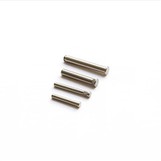
Marking methods for mini shafts are crucial in various industries, especially for a mini shaft supplier like me. These methods not only help in product identification but also play a significant role in quality control and traceability. In this blog, I will delve into the different marking methods suitable for mini shafts, their advantages and disadvantages, and considerations when choosing the right marking option.
Laser Marking
Laser marking is one of the most popular methods for marking mini shafts. It uses a high - energy laser beam to create a permanent mark on the surface of the shaft. The laser beam vaporizes or changes the color of the material, depending on the type of laser and the material of the shaft.
There are several types of lasers commonly used for marking mini shafts, such as fiber lasers, CO2 lasers, and Nd:YAG lasers. Fiber lasers are very efficient for marking metals, including stainless steel used in Stainless Steel Mini Shaft. They can produce high - contrast, precise marks with excellent durability. CO2 lasers, on the other hand, are more suitable for marking non - metallic materials or creating deeper engravings on some metals. Nd:YAG lasers offer a good balance between power and precision and can be used for a wide range of materials.
The advantages of laser marking are numerous. First of all, it provides high - resolution marks. The laser can create very fine lines and detailed patterns, which is essential for marking serial numbers, logos, or other small - scale information on mini shafts. Secondly, laser marking is a non - contact process. This means that there is no mechanical stress applied to the shaft during marking, reducing the risk of damage to the delicate mini shaft. Additionally, laser - marked products are highly resistant to wear, corrosion, and fading, ensuring long - term legibility.
However, laser marking also has some limitations. The initial investment in laser marking equipment can be quite high. The cost of purchasing and installing a laser marking system may be a significant barrier for small - scale suppliers. Moreover, the marking speed may be relatively slow when compared to some other marking methods, especially for large - volume production.
Inkjet Marking
Inkjet marking is another option for marking mini shafts. It works by ejecting tiny droplets of ink onto the surface of the shaft to form the desired mark. There are two main types of inkjet marking: continuous inkjet (CIJ) and drop - on - demand (DOD).
CIJ systems continuously force ink through a nozzle, creating a stream of droplets. Some of these droplets are deflected by an electric field to form the mark, while the rest are recirculated back into the ink system. DOD systems, on the other hand, only eject ink droplets when needed.
One of the major advantages of inkjet marking is its speed. It can quickly mark a large number of mini shafts, making it suitable for high - volume production lines. Inkjet marking is also very flexible as it can be easily programmed to change the marking content, such as batch numbers or expiration dates. Additionally, it is relatively inexpensive in terms of equipment investment when compared to laser marking.
But inkjet marking also has drawbacks. The marks are not as durable as laser marks. The ink can wear off over time, especially if the mini shafts are exposed to harsh environments, such as high - temperature, high - humidity, or abrasive conditions. Also, the quality of the mark may be affected by factors like ink viscosity, surface cleanliness of the shaft, and the distance between the nozzle and the shaft surface.
Mechanical Marking
Mechanical marking involves physically indenting or engraving the surface of the mini shaft using a tool. This can be done through methods like dot peen marking and scribing.

Dot peen marking uses a pneumatic or electromechanical stylus to create a series of dots on the shaft surface, forming the desired mark. The dots can be arranged to create letters, numbers, or logos. Scribing, on the other hand, uses a sharp tool to cut a groove into the shaft surface.
The advantage of mechanical marking is its durability. The indented or engraved marks are very resistant to wear and can withstand harsh handling and environmental conditions. It is also a relatively simple and straightforward process, and the equipment is usually less expensive than laser marking systems.
However, mechanical marking has its own set of problems. Since it is a contact process, it can cause deformation or damage to the surface of the mini shaft, especially if the shaft is made of a soft material. Also, the marking resolution may be limited compared to laser marking, and it may not be suitable for very detailed or small - scale markings.
Chemical Marking
Chemical marking uses chemical solutions to etch or color the surface of the mini shaft. This can be achieved through processes like acid etching or anodizing in the case of aluminum shafts.
Acid etching involves applying an acid solution to the surface of the shaft through a stencil or masking process. The acid reacts with the metal, removing a thin layer of material and creating a visible mark. Anodizing is an electrochemical process that forms a protective oxide layer on the surface of aluminum shafts. By controlling the process, colored marks can be created on the anodized surface.
Chemical marking can produce high - quality, long - lasting marks. It can be used to create complex patterns and designs on the mini shaft. However, it requires careful handling of chemicals, which can be hazardous to human health and the environment. The process also needs to be carried out in a well - ventilated area with proper safety measures. Additionally, the setup for chemical marking can be time - consuming and costly.
Considerations When Choosing a Marking Method
When choosing a marking method for mini shafts, several factors need to be considered.
Material of the Shaft: Different materials respond differently to various marking methods. For example, laser marking is very effective for metals like stainless steel, while inkjet marking may be more appropriate for plastic or rubber mini shafts.
Marking Content and Quality Requirements: If the marking needs to be very detailed, such as high - resolution logos or small serial numbers, laser marking may be the best choice. For simple text or batch numbers, inkjet or mechanical marking may be sufficient.
Production Volume: High - volume production lines may benefit from fast - marking methods like inkjet marking. For low - volume or custom - made mini shafts, laser or mechanical marking may be more suitable.
Cost: The initial investment in equipment, as well as the ongoing costs of consumables (such as ink for inkjet marking or chemicals for chemical marking), should be taken into account.
Environmental Conditions: If the mini shafts will be used in harsh environments, a more durable marking method like laser or mechanical marking is recommended.
As a mini shaft supplier, I understand the importance of choosing the right marking method for our products. We strive to provide high - quality mini shafts with clear and durable markings to meet the needs of our customers. Whether you are looking for a small - batch custom - marked mini shaft or high - volume production with specific marking requirements, we are here to help.
If you are interested in our mini shafts and would like to discuss the marking options further or initiate a purchase, please feel free to reach out to us. We are more than happy to have in - depth discussions about your specific requirements and offer the most suitable solutions.
References
- "Industrial Marking Technologies: A Comprehensive Guide" by John Doe
- "Materials and Manufacturing Processes for Miniature Components" by Jane Smith
- "Advances in Laser Marking Techniques" published by the International Journal of Manufacturing Science