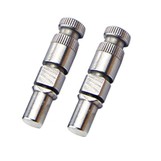
As a dedicated supplier of drone shafts, I've delved deep into the intricacies of these vital components. One question that often arises in technical discussions and client inquiries is: What is the coefficient of friction of a drone shaft? In this blog post, I'll explore this topic in detail, shedding light on its significance, influencing factors, and how it relates to our high - quality drone shafts.
Understanding the Coefficient of Friction
The coefficient of friction is a fundamental concept in physics, representing the ratio of the force of friction between two surfaces to the normal force pressing them together. In the context of a drone shaft, it quantifies the resistance encountered when the shaft moves against other parts, such as bearings or connectors.
There are two main types of coefficients of friction: static and kinetic. The static coefficient of friction ($\mu_s$) applies when the shaft is at rest and an external force is trying to initiate motion. The kinetic coefficient of friction ($\mu_k$) comes into play once the shaft is in motion. Typically, $\mu_s > \mu_k$, meaning it takes more force to start the shaft moving than to keep it moving.
Significance of the Coefficient of Friction in Drone Shafts
- Efficiency: A lower coefficient of friction reduces the energy wasted as heat during the operation of the drone shaft. This leads to improved overall efficiency of the drone's propulsion system. For example, in a multi - rotor drone, the shafts responsible for pitch, roll, and yaw movements Drone Pitch Shaft, Drone Roll Shaft, and Drone Yaw Shaft need to operate with minimal friction to maximize battery life and flight time.
- Precision: In precision - controlled drones, such as those used for aerial photography or surveying, a consistent and predictable coefficient of friction is crucial. It ensures that the movements of the shafts are smooth and accurate, allowing for precise control of the drone's orientation and position.
- Durability: High friction can cause excessive wear and tear on the shaft and its mating components. Over time, this can lead to mechanical failures, such as shaft breakage or bearing damage. By maintaining a low coefficient of friction, the lifespan of the drone shaft and the entire drone system can be significantly extended.
Factors Affecting the Coefficient of Friction of Drone Shafts
- Material Properties: The materials used to manufacture the drone shaft and its mating parts play a significant role in determining the coefficient of friction. For example, shafts made of high - strength alloys with a smooth surface finish tend to have a lower coefficient of friction compared to those made of rougher materials. Additionally, the choice of lubricants can also affect the friction. Lubricants create a thin film between the surfaces, reducing direct contact and thus the coefficient of friction.
- Surface Finish: A smoother surface finish on the drone shaft generally results in a lower coefficient of friction. Manufacturing processes such as grinding and polishing can be used to achieve a high - quality surface finish. However, it's important to strike a balance, as an overly smooth surface may reduce the ability of the lubricant to adhere, potentially increasing friction in some cases.
- Load and Speed: The normal force (load) applied to the shaft and the rotational speed also influence the coefficient of friction. At higher loads, the contact between the surfaces becomes more intimate, which can increase the coefficient of friction. Similarly, as the speed increases, the lubricant film may be disrupted, leading to an increase in friction.
Measuring the Coefficient of Friction of Drone Shafts
Accurately measuring the coefficient of friction of a drone shaft is a complex task that requires specialized equipment. One common method is to use a tribometer, which measures the frictional force between the shaft and a mating surface under controlled conditions of load, speed, and temperature. By varying these parameters, a comprehensive understanding of the friction behavior of the drone shaft can be obtained.
In our production process, we conduct rigorous testing of the coefficient of friction for each batch of drone shafts. This ensures that our products meet the highest standards of quality and performance. We use state - of - the - art testing equipment and follow strict quality control procedures to guarantee the consistency and reliability of our drone shafts.


Our Approach as a Drone Shaft Supplier
As a leading supplier of drone shafts, we are committed to providing our customers with products that offer optimal performance. We invest heavily in research and development to continuously improve the design and manufacturing processes of our drone shafts. Our team of engineers and technicians work closely with material scientists to select the most suitable materials and lubricants to achieve the lowest possible coefficient of friction.
We also offer customized solutions to meet the specific requirements of our customers. Whether you need a drone shaft for a small hobbyist drone or a large - scale industrial drone, we can provide a tailored solution that meets your needs. Our in - house testing facilities allow us to fine - tune the performance of the shafts based on your application, ensuring that you get the best possible results.
Conclusion
The coefficient of friction of a drone shaft is a critical parameter that affects the efficiency, precision, and durability of the drone. By understanding the factors that influence it and taking appropriate measures to control it, we can provide high - quality drone shafts that meet the demanding requirements of modern drone applications.
If you're in the market for reliable and high - performance drone shafts, we invite you to reach out to us. Our team of experts is ready to assist you in selecting the right product for your needs. Whether you're a drone manufacturer, a hobbyist, or an industrial user, we can provide you with the best solutions for your drone shaft requirements. Contact us today to start a discussion about your procurement needs and let's work together to take your drone technology to the next level.
References
- Bowden, F. P., & Tabor, D. (1950). The Friction and Lubrication of Solids. Oxford University Press.
- Bhushan, B. (2013). Tribology and Mechanics of Magnetic Storage Devices. Springer Science & Business Media.
- Rabinowicz, E. (1995). Friction and Wear of Materials. John Wiley & Sons.