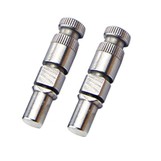
In the realm of mechanical engineering, the eccentric shaft stands as a remarkable yet often under - appreciated component. As a dedicated eccentric shaft supplier, I've witnessed firsthand the diverse and crucial functions these shafts serve across a wide range of industries. In this blog, we'll delve deep into the functions of an eccentric shaft, exploring its applications and significance.
1. Understanding the Basics of an Eccentric Shaft
Before we jump into its functions, let's briefly understand what an eccentric shaft is. An eccentric shaft is a mechanical device with its axis of rotation offset from the centerline of the shaft. This offset, or eccentricity, is what gives the shaft its unique properties and capabilities.
Eccentric shafts can be made from various materials, including steel, stainless steel, and even some high - performance alloys. For instance, our Stainless Steel Eccentric Shaft offers excellent corrosion resistance, making it suitable for applications in harsh environments.
2. Conversion of Rotary Motion to Linear Motion
One of the primary functions of an eccentric shaft is to convert rotary motion into linear motion. This conversion is fundamental in many mechanical systems. Consider a reciprocating engine, where the piston needs to move back and forth in a linear path. The eccentric shaft, connected to the crankshaft, plays a pivotal role here. As the crankshaft rotates, the eccentric shaft's offset causes it to push and pull a connecting rod, which in turn moves the piston linearly.


This function is also utilized in various types of pumps. In a diaphragm pump, for example, the eccentric shaft rotates, and through a linkage system, it causes the diaphragm to move in and out. This movement creates a pumping action, allowing the pump to transfer fluids. Our Precision Eccentric Shaft is designed to provide accurate and smooth conversion of rotary to linear motion, ensuring the efficient operation of such mechanical systems.
3. Generating Oscillatory Motion
Another important function of an eccentric shaft is to generate oscillatory motion. Oscillatory motion is a repetitive back - and - forth movement around a central position. In a vibratory feeder, an eccentric shaft is used to create the vibration necessary to move materials along a track. As the shaft rotates, the eccentricity causes an unbalanced force, which results in the oscillatory motion of the feeder.
This function is also valuable in some types of testing equipment. For example, in a fatigue testing machine, the eccentric shaft can be used to apply an oscillating load to a test specimen. By carefully controlling the rotation speed and eccentricity of the shaft, engineers can simulate real - world conditions and test the durability of materials and components.
4. Controlling Timing and Phasing
Eccentric shafts are also crucial for controlling the timing and phasing of mechanical events. In a cam - driven system, the eccentric shaft can be used to drive the cam. The offset of the eccentric shaft determines when the cam will actuate a follower, which could be a valve in an engine or a switch in an electrical system.
By adjusting the eccentricity and the position of the eccentric shaft, engineers can precisely control the timing of these events. This is essential in engines, where the opening and closing of valves need to be synchronized with the movement of the pistons for optimal performance. In automated machinery, accurate timing and phasing ensure that different components work together seamlessly, preventing collisions and improving overall efficiency.
5. Load Distribution and Force Transmission
Eccentric shafts are effective in distributing loads and transmitting forces in mechanical systems. In a press machine, the eccentric shaft can be used to transfer the force from the motor to the ram. The offset design of the shaft allows it to amplify the force, enabling the press to exert a high - pressure force on a workpiece.
This load - distribution function is also important in heavy - duty machinery, such as crushers and forging presses. The eccentric shaft helps to evenly distribute the load across different components, reducing stress concentrations and increasing the lifespan of the equipment. Our high - quality eccentric shafts are designed to handle large loads and transmit forces efficiently, ensuring the reliability of these heavy - duty applications.
6. Applications in Different Industries
The functions of eccentric shafts make them indispensable in a variety of industries. In the automotive industry, they are used in engines, transmissions, and suspension systems. In the manufacturing industry, they are found in presses, stamping machines, and conveyor systems. In the food and beverage industry, they are used in packaging machinery and filling equipment.
In the aerospace industry, eccentric shafts are used in some types of actuators and control systems. Their ability to convert motion and control timing is crucial for the precise operation of aircraft components. Even in the textile industry, eccentric shafts are used in weaving machines to control the movement of the warp and weft threads.
7. Quality and Customization
As a supplier, we understand the importance of providing high - quality eccentric shafts. Our manufacturing process involves advanced CNC machining techniques to ensure precise dimensions and smooth surfaces. We also offer customization options, allowing customers to specify the eccentricity, diameter, length, and material of the shaft according to their specific requirements.
Whether you need a small - scale eccentric shaft for a precision instrument or a large - scale shaft for heavy - duty machinery, we have the expertise and capabilities to meet your needs. Our team of engineers is always ready to work with you to design and manufacture the perfect eccentric shaft for your application.
8. Contact Us for Your Eccentric Shaft Needs
If you're in the market for eccentric shafts, we invite you to get in touch with us. Our extensive experience as a supplier and our commitment to quality make us a reliable partner for your mechanical component needs. Whether you're an engineer looking for a specific design or a manufacturer in need of a large - volume supply, we can provide the solutions you require.
We are dedicated to providing excellent customer service and ensuring that our products meet the highest standards. Contact us today to discuss your requirements and start a fruitful partnership.
References
- Norton, Robert L. "Machine Design: An Integrated Approach." Prentice Hall, 2006.
- Shigley, Joseph E., and Charles R. Mischke. "Mechanical Engineering Design." McGraw - Hill, 2003.
- Spotts, Milton F., et al. "Design of Machine Elements." Prentice Hall, 2004.