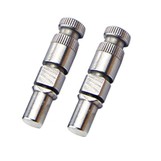
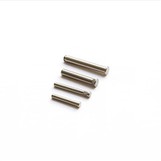
Yo, what's up everyone! I'm a supplier of mini shafts, and today I wanna chat about something super important in the world of mini shafts - the modulus of elasticity.
First off, let's break down what the modulus of elasticity even is. In simple terms, it's a measure of how a material resists being deformed when a force is applied to it. It's kinda like how tough a muscle is. If you push on a really strong muscle, it doesn't squish easily, right? Well, the modulus of elasticity is like the "strength" of a material under stress.
For a mini shaft, this property is crucial. You see, mini shafts are used in all sorts of applications, from small mechanical devices to precision instruments. They need to be able to handle different kinds of forces without getting all bent out of shape. Whether it's a rotational force when the shaft is spinning, or a linear force when it's being pushed or pulled, the modulus of elasticity determines how much the shaft will deform under these loads.
Let's take a look at the materials commonly used for mini shafts and their modulus of elasticity. One of the most popular materials is stainless steel. Stainless steel is known for its durability, corrosion resistance, and good mechanical properties. When it comes to the modulus of elasticity, stainless steel has a relatively high value. This means that a Stainless Steel Mini Shaft can withstand a fair amount of stress without significant deformation.

The reason why a high modulus of elasticity is so important for a mini shaft is that it ensures the precision and reliability of the device it's used in. For example, in a precision watch, the mini shaft needs to rotate smoothly and accurately. If the shaft has a low modulus of elasticity, it might bend or twist under the normal operating forces, which could throw off the entire time - keeping mechanism.
Another material that's used for mini shafts is aluminum. Aluminum is lighter than stainless steel, which can be an advantage in some applications where weight is a concern. However, its modulus of elasticity is lower than that of stainless steel. So, while an aluminum mini shaft might be lighter, it won't be able to handle as much force without deforming.
When I'm working with customers, I always have to consider the modulus of elasticity based on their specific needs. If they're building a high - performance machine that requires a lot of torque and strength, I'll usually recommend a stainless steel mini shaft. But if weight is a priority and the forces involved are relatively low, an aluminum mini shaft might be the better choice.
Now, let's talk about how the modulus of elasticity actually affects the design and manufacturing of mini shafts. When we're designing a mini shaft, we need to know the expected loads it will face. Based on the modulus of elasticity of the chosen material, we can calculate the size and shape of the shaft to ensure it can handle those loads. For example, if we know that a shaft will be under a lot of torsional stress, we might increase its diameter or change its cross - sectional shape to improve its resistance to twisting.
In the manufacturing process, the modulus of elasticity also plays a role. Different materials respond differently to machining processes. For instance, stainless steel, with its high modulus of elasticity, might require more powerful cutting tools and slower machining speeds compared to aluminum. This is because the high - strength material is more resistant to deformation, so it takes more force to cut and shape it.
One of the challenges I face as a mini shaft supplier is to make sure that I can provide my customers with shafts that meet their exact requirements in terms of the modulus of elasticity. That means having a good understanding of the materials and how they perform, as well as the ability to test and verify the properties of the finished shafts.
To do this, I rely on a combination of advanced testing equipment and quality control processes. We use techniques like tensile testing to measure the modulus of elasticity accurately. By pulling a sample of the shaft material at a controlled rate and measuring the resulting deformation, we can calculate the modulus of elasticity. This ensures that the shafts we supply have the right mechanical properties for their intended applications.
I also stay up - to - date with the latest research and developments in materials science. New materials are constantly being developed, and some of them might offer better properties in terms of the modulus of elasticity or other important characteristics. By keeping an eye on these advancements, I can offer my customers the best possible solutions for their mini shaft needs.
If you're in the market for mini shafts, whether it's a Stainless Steel Mini Shaft or something made from a different material, it's crucial to understand the importance of the modulus of elasticity. It's not just a technical jargon; it's a key factor that can determine the performance and reliability of your device.
So, if you have any questions about mini shafts or need help choosing the right one for your project, don't hesitate to reach out. I'm here to help you make the best decision based on your specific requirements. Whether you're building a small - scale machine or a high - precision instrument, I can provide you with high - quality mini shafts that meet your needs. Contact me, and let's start a conversation about how I can assist you in getting the perfect mini shafts for your application.
References
- Callister, W. D., & Rethwisch, D. G. (2016). Materials Science and Engineering: An Introduction. Wiley.
- Ashby, M. F. (2011). Materials Selection in Mechanical Design. Butterworth - Heinemann.