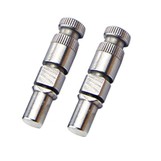
As a seasoned pinion shaft supplier, I've witnessed firsthand the diverse requirements and preferences of our customers. One of the most frequently asked questions revolves around the performance differences between forged and machined pinion shafts. In this blog post, I'll delve into the intricacies of these two manufacturing methods, exploring their unique characteristics, advantages, and limitations.
Understanding Forged Pinion Shafts
Forging is a manufacturing process that involves shaping metal through the application of compressive forces. In the case of pinion shafts, a heated metal billet is placed in a die and hammered or pressed into the desired shape. This process aligns the grain structure of the metal, resulting in a stronger and more durable shaft.
One of the primary advantages of forged pinion shafts is their superior strength. The forging process compresses the metal, eliminating internal voids and defects that can weaken the shaft. This results in a shaft that can withstand higher loads and stresses without deforming or breaking. For applications that require high torque and power transmission, such as automotive transmissions and industrial machinery, forged pinion shafts are often the preferred choice.
Another benefit of forged pinion shafts is their excellent fatigue resistance. The aligned grain structure of the metal provides a more uniform distribution of stress, reducing the likelihood of crack initiation and propagation. This makes forged pinion shafts ideal for applications that involve repeated loading and unloading, such as in heavy-duty equipment and high-speed machinery.
In addition to their strength and fatigue resistance, forged pinion shafts also offer good dimensional stability. The forging process allows for precise control over the shape and size of the shaft, ensuring consistent quality and performance. This is particularly important for applications that require tight tolerances and precise alignment, such as in precision machinery and aerospace components.
However, forged pinion shafts also have some limitations. The forging process is relatively expensive and time-consuming, especially for complex shapes and small production runs. Additionally, the size and shape of the forged shaft are limited by the capabilities of the forging equipment and the size of the metal billet. This can make it difficult to produce large or intricate pinion shafts using the forging method.
Exploring Machined Pinion Shafts
Machining is a manufacturing process that involves removing material from a workpiece using cutting tools. In the case of pinion shafts, a solid metal bar is mounted on a lathe or milling machine, and the excess material is removed to create the desired shape and size. This process allows for greater flexibility in terms of design and customization, as well as the ability to produce complex shapes and features.
One of the main advantages of machined pinion shafts is their versatility. The machining process can be used to produce pinion shafts of various sizes, shapes, and materials, including Stainless Steel Pinion Shaft. This makes it possible to meet the specific requirements of different applications, from small precision components to large industrial shafts.
Another benefit of machined pinion shafts is their high precision. The use of advanced machining techniques and equipment allows for tight tolerances and accurate dimensions, ensuring a perfect fit and smooth operation. This is particularly important for applications that require precise gear meshing and alignment, such as in automotive transmissions and robotics.


In addition to their precision, machined pinion shafts also offer good surface finish. The machining process can produce a smooth and uniform surface, which reduces friction and wear, and improves the efficiency and reliability of the shaft. This is especially important for applications that involve high-speed rotation and sliding contact, such as in bearings and gears.
However, machined pinion shafts also have some drawbacks. The machining process can be time-consuming and expensive, especially for complex shapes and tight tolerances. Additionally, the removal of material during machining can weaken the shaft, especially if the cutting forces are not properly controlled. This can result in reduced strength and fatigue resistance compared to forged pinion shafts.
Performance Comparison
When comparing the performance of forged and machined pinion shafts, several factors need to be considered, including strength, fatigue resistance, dimensional stability, precision, and surface finish.
In terms of strength, forged pinion shafts generally have an advantage over machined pinion shafts. The forging process aligns the grain structure of the metal, resulting in a stronger and more durable shaft. This makes forged pinion shafts better suited for applications that require high torque and power transmission, such as in heavy-duty equipment and automotive transmissions.
In terms of fatigue resistance, forged pinion shafts also tend to perform better than machined pinion shafts. The aligned grain structure of the metal provides a more uniform distribution of stress, reducing the likelihood of crack initiation and propagation. This makes forged pinion shafts ideal for applications that involve repeated loading and unloading, such as in high-speed machinery and aerospace components.
In terms of dimensional stability, forged pinion shafts offer better control over the shape and size of the shaft. The forging process allows for precise control over the metal flow, ensuring consistent quality and performance. This is particularly important for applications that require tight tolerances and precise alignment, such as in precision machinery and robotics.
In terms of precision and surface finish, machined pinion shafts have an advantage over forged pinion shafts. The machining process can produce a smooth and uniform surface, which reduces friction and wear, and improves the efficiency and reliability of the shaft. This is especially important for applications that involve high-speed rotation and sliding contact, such as in bearings and gears.
Choosing the Right Pinion Shaft
The choice between a forged and a machined pinion shaft depends on several factors, including the specific application requirements, the budget, and the production volume.
For applications that require high strength, fatigue resistance, and dimensional stability, such as in heavy-duty equipment and automotive transmissions, forged pinion shafts are often the preferred choice. The forging process provides a stronger and more durable shaft that can withstand the high loads and stresses associated with these applications.
For applications that require high precision, surface finish, and design flexibility, such as in precision machinery and aerospace components, machined pinion shafts are often the better option. The machining process allows for greater control over the shape and size of the shaft, as well as the ability to produce complex shapes and features.
In some cases, a combination of forging and machining may be used to produce the best possible pinion shaft. For example, a forged blank can be machined to achieve the final shape and dimensions, combining the strength and durability of forging with the precision and flexibility of machining.
Conclusion
In conclusion, both forged and machined pinion shafts have their own unique advantages and limitations. The choice between the two depends on the specific application requirements, the budget, and the production volume. As a pinion shaft supplier, we have the expertise and experience to help you choose the right manufacturing method for your needs. Whether you require a Stainless Steel Pinion Shaft or a Precision Pinion Shaft, we can provide you with high-quality products that meet your specifications. If you have any questions or would like to discuss your pinion shaft requirements, please don't hesitate to contact us. We look forward to working with you to find the perfect solution for your application.
References
- Kalpakjian, S., & Schmid, S. R. (2010). Manufacturing Engineering and Technology. Pearson Prentice Hall.
- Dieter, G. E. (1988). Mechanical Metallurgy. McGraw-Hill.
- Groover, M. P. (2010). Fundamentals of Modern Manufacturing: Materials, Processes, and Systems. Wiley.