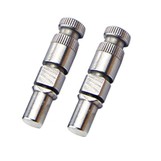
Hey there! I'm a supplier of fixed shafts, and today I wanna chat about the straightness requirement for a fixed shaft. It's a topic that's super important in our line of work, and I'm stoked to share my insights with you.
First off, let's talk about what straightness means in the context of a fixed shaft. Simply put, straightness refers to how closely a shaft conforms to a perfectly straight line. In the real world, achieving absolute straightness is pretty much impossible, but we aim for the closest approximation we can get. Why? Well, a shaft that's not straight can cause all sorts of problems. It can lead to uneven wear and tear on bearings, which can shorten their lifespan. It can also affect the performance of the machinery the shaft is a part of, causing vibrations, noise, and even reduced efficiency.
So, how do we measure the straightness of a fixed shaft? There are a few different methods, but one of the most common is using a dial indicator. You place the shaft on V-blocks, and then you run the dial indicator along the length of the shaft. Any deviation from a straight line will be shown on the indicator. Another method is using optical measurement systems, which can provide more accurate and detailed information about the shaft's straightness.
Now, what are the typical straightness requirements for a fixed shaft? Well, it really depends on the application. For some general-purpose applications, a straightness tolerance of around 0.05 mm per meter of shaft length might be acceptable. But for more precision applications, like in the aerospace or automotive industries, the tolerance can be much tighter, sometimes as low as 0.001 mm per meter.
Let's take a look at some specific examples. In a simple conveyor system, the straightness requirements might not be as strict. As long as the shaft is straight enough to ensure smooth movement of the conveyor belt and doesn't cause excessive wear on the bearings, it should be fine. On the other hand, in a high-speed motor, a tiny deviation in straightness can lead to significant vibrations, which can damage the motor and reduce its efficiency. So, in this case, the straightness requirements are much more stringent.
As a fixed shaft supplier, we understand the importance of meeting these straightness requirements. That's why we use state-of-the-art manufacturing and inspection equipment to ensure that our shafts meet the highest standards. We also have a team of experienced engineers who can work with you to determine the right straightness requirements for your specific application.
If you're in the market for high-quality fixed shafts, we've got you covered. We offer a wide range of fixed shafts, including Precision Fixed Shaft and Stainless Steel Fixed Shaft. Our precision fixed shafts are designed for applications that require the highest level of accuracy and performance. They're made from high-quality materials and are manufactured using advanced CNC machining techniques to ensure tight tolerances and excellent straightness. Our stainless steel fixed shafts, on the other hand, are ideal for applications that require corrosion resistance. They're made from premium stainless steel and are available in a variety of sizes and finishes.
Whether you need a single fixed shaft or a large batch, we can provide you with the right solution at a competitive price. We're committed to providing our customers with the best products and services, and we'll work closely with you to ensure that your needs are met.
So, if you're interested in learning more about our fixed shafts or have any questions about straightness requirements, don't hesitate to get in touch. We'd love to have a chat with you and discuss how we can help you with your fixed shaft needs.
In conclusion, straightness is a critical factor when it comes to fixed shafts. It can have a significant impact on the performance and lifespan of the machinery they're used in. As a supplier, we're dedicated to providing our customers with fixed shafts that meet the highest straightness requirements. If you're looking for a reliable partner for your fixed shaft needs, look no further. Contact us today, and let's start a conversation!


References
- Machinery's Handbook, 31st Edition
- ASME Y14.5 - 2018 Geometric Dimensioning and Tolerancing
- ISO 1101 - Geometrical product specifications (GPS) - Geometric tolerancing - Tolerances of form, orientation, location and run - out