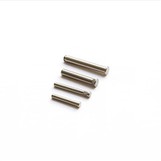
Hey there! As a knurled shaft supplier, I've seen firsthand how these nifty components can make a huge difference in grip. So, let's dive into how a knurled shaft improves grip and why it's such a game-changer in various industries.


First off, what exactly is a knurled shaft? Well, it's a shaft that has a pattern of small ridges or bumps on its surface. These patterns can come in different shapes, like straight, diamond, or crosshatch. The purpose of these patterns is to increase the friction between the shaft and whatever is gripping it, whether it's a hand, a tool, or another mechanical part.
One of the main ways a knurled shaft improves grip is by increasing the surface area. When you have a smooth shaft, there's not much for your hand or a tool to hold onto. But when you add those little ridges, it creates more contact points, which means more friction. This is especially important in situations where you need a firm grip, like when you're using a tool to turn a knob or when you're holding onto a handle.
Let's take a look at some real-world examples. In the automotive industry, knurled shafts are often used in steering wheels. The knurled pattern on the shaft provides a better grip for the driver, making it easier to turn the wheel and control the vehicle. This is especially important in high-stress situations, like when you're driving on a wet or slippery road.
Another example is in the manufacturing industry. Knurled shafts are used in a variety of machines, from lathes to drills. The knurled pattern on the shaft helps to prevent the tool from slipping out of the operator's hand, which can be dangerous. It also makes it easier to apply the right amount of force when using the tool, which can improve the quality of the work.
Now, let's talk about the different types of knurled patterns and how they affect grip. The most common types of knurled patterns are straight, diamond, and crosshatch. Each type of pattern has its own unique properties and is suitable for different applications.
Straight knurling is the simplest type of knurling. It consists of a series of parallel ridges that run along the length of the shaft. This type of knurling is often used in applications where a simple, straightforward grip is needed, like on a doorknob or a handle.
Diamond knurling is a more complex pattern that consists of a series of diamond-shaped ridges. This type of knurling provides a more aggressive grip than straight knurling and is often used in applications where a stronger grip is needed, like on a tool handle or a steering wheel.
Crosshatch knurling is a combination of straight and diamond knurling. It consists of a series of intersecting ridges that form a crosshatch pattern. This type of knurling provides the most aggressive grip of all and is often used in applications where a very strong grip is needed, like on a high-torque tool or a heavy-duty machine.
In addition to the type of knurled pattern, the size and depth of the ridges also affect grip. Generally speaking, the larger and deeper the ridges, the better the grip. However, it's important to find the right balance between grip and comfort. If the ridges are too large or too deep, they can be uncomfortable to hold onto for long periods of time.
Now, let's talk about the materials used to make knurled shafts. Knurled shafts can be made from a variety of materials, including steel, aluminum, brass, and stainless steel. Each material has its own unique properties and is suitable for different applications.
Steel is a popular choice for knurled shafts because it is strong, durable, and relatively inexpensive. It is often used in applications where a high level of strength and durability is required, like in the automotive and manufacturing industries.
Aluminum is a lightweight and corrosion-resistant material that is often used in applications where weight is a concern, like in the aerospace and automotive industries. It is also a good choice for applications where a smooth, clean appearance is desired.
Brass is a soft and malleable material that is often used in applications where a decorative finish is desired. It is also a good choice for applications where a low level of friction is required, like in electrical contacts.
Stainless steel is a corrosion-resistant and strong material that is often used in applications where a high level of hygiene is required, like in the food and beverage industry. It is also a good choice for applications where a long lifespan is desired.
As a knurled shaft supplier, we offer a wide range of knurled shafts to meet the needs of our customers. Whether you need a precision knurled shaft for a high-tech application or a stainless steel knurled shaft for a food processing plant, we've got you covered.
If you're interested in learning more about our knurled shafts or if you have any questions, please don't hesitate to contact us. We'd be happy to help you find the right knurled shaft for your application. You can check out our Precision Knurled Shaft and Stainless Steel Knurled Shaft on our website for more details.
In conclusion, a knurled shaft is a simple yet effective way to improve grip in a variety of applications. By increasing the surface area and providing more contact points, a knurled shaft can help to prevent slipping and make it easier to hold onto tools and other objects. Whether you're in the automotive, manufacturing, or any other industry, a knurled shaft can be a valuable addition to your equipment. So, if you're looking for a way to improve grip and increase safety, consider using a knurled shaft.
References
- Machinery's Handbook, 31st Edition
- ASME Y14.8 - Dimensioning and Tolerancing of Forgings
- ISO 230 - Test code for machine tools