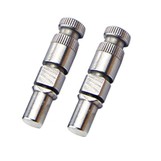
Hey there! As a supplier of fixed shafts, I often get asked about the torque requirements for these components. Torque is a crucial factor when it comes to the performance and reliability of fixed shafts, so I thought I'd share some insights on this topic.
First off, let's understand what torque is. In simple terms, torque is the rotational force applied to an object. When it comes to fixed shafts, torque determines how well the shaft can handle the load and perform its intended function. Whether it's in a machine tool, automotive application, or any other industrial setting, the right torque is essential for smooth operation.
The torque requirements for a fixed shaft depend on several factors. One of the primary factors is the application itself. Different applications have different demands, and the torque needed will vary accordingly. For example, in a high - speed machining center, the fixed shaft may need to withstand high - frequency torque fluctuations. On the other hand, in a slow - moving conveyor system, the torque requirements might be more stable but still significant.
Another important factor is the material of the fixed shaft. We offer a variety of fixed shafts, such as the Precision Fixed Shaft and the Stainless Steel Fixed Shaft. Each material has its own mechanical properties that affect the torque it can handle. Stainless steel, for instance, is known for its high strength and corrosion resistance. This means that a stainless steel fixed shaft can generally withstand higher torques compared to a shaft made from a less - robust material.
The diameter and length of the fixed shaft also play a crucial role in determining the torque requirements. A larger - diameter shaft can typically handle more torque because it has a greater cross - sectional area, which provides more resistance to bending and twisting. Similarly, a shorter shaft is often stiffer and can transmit torque more effectively than a longer one.
Let's talk about how to calculate the torque requirements for a fixed shaft. There are several methods, but one of the most common is based on the power and speed of the system. The formula for torque (T) in terms of power (P) and angular velocity (ω) is T = P/ω. The power is usually measured in watts, and the angular velocity is in radians per second.
However, this is a simplified calculation. In real - world applications, we also need to consider factors like friction, efficiency losses, and dynamic loads. For example, if there is a lot of friction in the system, more torque will be required to overcome it and keep the shaft rotating smoothly.
When it comes to dynamic loads, things get a bit more complicated. Dynamic loads can occur due to sudden starts, stops, or changes in speed. These loads can generate much higher torques than the steady - state loads. To account for dynamic loads, engineers often use safety factors. A safety factor is a multiplier applied to the calculated torque to ensure that the shaft can handle the unexpected loads without failing.
As a fixed shaft supplier, we understand that getting the torque requirements right is crucial for our customers. That's why we work closely with our clients to understand their specific applications and provide them with the best - suited fixed shafts. We have a team of experts who can help with torque calculations and recommend the most appropriate shaft material, diameter, and length.
If you're in the market for fixed shafts and need to figure out the torque requirements for your application, don't hesitate to reach out. We're here to assist you in making the right choice. Whether it's a Precision Fixed Shaft for a high - precision application or a Stainless Steel Fixed Shaft for a corrosive environment, we've got you covered.


Contact us today to start the conversation about your fixed shaft needs. We're confident that we can provide you with high - quality fixed shafts that meet your torque requirements and perform reliably in your application.
References
- Shigley, J. E., & Mischke, C. R. (2001). Mechanical Engineering Design. McGraw - Hill.
- Budynas, R. G., & Nisbett, J. K. (2011). Shigley's Mechanical Engineering Design. McGraw - Hill.