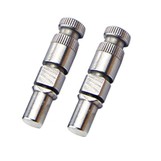
In the precision engineering field, mini shafts play a crucial role in various applications, from miniature motors to high - tech medical devices. As a dedicated mini shaft supplier, I've witnessed firsthand the importance of understanding every aspect of these tiny yet powerful components. One of the most critical factors that often goes unnoticed but significantly impacts the performance of mini shafts is concentricity.
Defining Concentricity
Concentricity refers to the degree to which the center axis of a feature (in this case, a mini shaft) aligns with a reference axis. In the context of a mini shaft, it is about how well the outer diameter of the shaft is centered around its ideal central axis. Imagine a perfectly straight line running through the middle of the shaft from one end to the other. The closer the actual outer surface of the shaft is to being symmetrically distributed around this line, the higher the concentricity.
Mathematically, concentricity is measured as the maximum distance that the center of a cross - section of the shaft deviates from the reference axis over the entire length of the shaft. For example, if we take multiple cross - sections along the length of a mini shaft and measure the distance between the center of each cross - section and the reference axis, the largest of these distances represents the concentricity error.
Why Concentricity Matters in Mini Shafts
1. Smooth Rotation
In applications where the mini shaft is used for rotational purposes, such as in small electric motors or precision gears, high concentricity is essential. When a shaft has poor concentricity, it will not rotate smoothly. Instead, it will cause vibrations as it spins. These vibrations can lead to increased wear and tear on the shaft itself, as well as on the bearings and other components that interact with the shaft. Over time, this can significantly reduce the lifespan of the entire system.
2. Precision in Transmission
Mini shafts are often used to transmit power or motion in precision machinery. If the concentricity is off, the power transmission will not be accurate. For instance, in a micro - robotic arm, a misaligned mini shaft can cause the arm to move with less precision, resulting in errors in tasks such as pick - and - place operations. This lack of precision can be a deal - breaker in industries where high accuracy is required, like electronics manufacturing and medical device assembly.
3. Noise Reduction
Shafts with good concentricity produce less noise during operation. In applications where quiet operation is a priority, such as in consumer electronics or medical equipment, minimizing noise is crucial. A well - centered mini shaft rotates quietly, providing a more pleasant user experience and reducing the risk of disturbing the surrounding environment.
Measuring Concentricity
There are several methods to measure the concentricity of a mini shaft. One of the most common techniques is using a coordinate measuring machine (CMM). A CMM is a highly accurate device that can precisely measure the dimensions and geometry of an object. To measure the concentricity of a mini shaft using a CMM, the shaft is placed on the machine's measuring table. The CMM then uses a probe to touch multiple points on the surface of the shaft at different cross - sections along its length. By analyzing the data collected from these points, the machine can calculate the center of each cross - section and determine the deviation from the reference axis.
Another method is using a dial indicator. A dial indicator is a simple yet effective tool for measuring small displacements. It can be set up to measure the runout of the shaft as it rotates. Runout is related to concentricity; excessive runout indicates poor concentricity. The dial indicator is placed against the surface of the shaft, and as the shaft rotates, the indicator needle moves, showing the amount of deviation.

Factors Affecting Concentricity
1. Manufacturing Processes
The way a mini shaft is manufactured has a significant impact on its concentricity. For example, in turning operations, if the cutting tool is not properly aligned or if the workpiece is not held securely in the chuck, it can lead to uneven material removal and poor concentricity. Similarly, in grinding processes, any misalignment of the grinding wheel or the workpiece can result in a shaft with off - center features.
2. Material Properties
The material of the mini shaft also plays a role. Some materials may be more prone to deformation during manufacturing or use. For instance, if a shaft is made of a soft material and is subjected to high - stress conditions during installation or operation, it may deform slightly, affecting its concentricity. On the other hand, a high - quality, well - heat - treated stainless steel shaft, like our Stainless Steel Mini Shaft, is more likely to maintain its concentricity over time due to its better mechanical properties.
3. Heat Treatment
Heat treatment processes can either improve or degrade the concentricity of a mini shaft. If the heat treatment is not carried out correctly, it can cause internal stresses in the shaft. These internal stresses can lead to distortion as the shaft cools, resulting in poor concentricity. However, when heat treatment is properly controlled, it can enhance the mechanical properties of the shaft and help maintain its shape and concentricity.
Ensuring High Concentricity in Mini Shafts
As a mini shaft supplier, we take several steps to ensure that the shafts we produce have high concentricity. First, we use state - of - the - art manufacturing equipment. Our CNC machining centers are equipped with advanced control systems that can precisely control the cutting and shaping processes. This allows us to achieve tight tolerances and high - quality surface finishes, which are essential for good concentricity.
We also have a strict quality control process in place. Every mini shaft undergoes multiple inspections during and after the manufacturing process. We use the latest measuring tools, such as CMMs and dial indicators, to check the concentricity and other critical dimensions of the shafts. Any shaft that does not meet our strict quality standards is rejected.
In addition, we carefully select the materials for our mini shafts. We source high - quality metals, such as stainless steel and titanium, which have excellent mechanical properties and are less likely to deform. We also work closely with our heat treatment partners to ensure that the heat treatment processes are carried out accurately, minimizing the risk of distortion.
Conclusion
Concentricity is a vital characteristic of mini shafts that can significantly impact their performance and the performance of the systems in which they are used. As a mini shaft supplier, we understand the importance of providing high - quality shafts with excellent concentricity. Our commitment to using advanced manufacturing techniques, strict quality control, and high - grade materials ensures that our customers receive mini shafts that meet their most demanding requirements.
If you are in the market for high - precision mini shafts with exceptional concentricity, we invite you to contact us for a detailed discussion. Our team of experts is ready to assist you in finding the perfect mini shaft solutions for your specific applications. Whether you need a small batch for prototyping or a large - scale production run, we have the capabilities to meet your needs.
References
- "Precision Engineering: Theory and Practice" by John R. F. Turner
- "Manufacturing Engineering and Technology" by S. Kalpakjian and S. R. Schmid
- "Mechanical Design of Machine Elements and Machines: A Failure Prevention Perspective" by Jack A. Collins and J. Gordon Kelsall