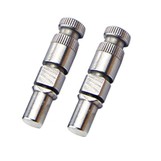
Hey there! As a robot shaft supplier, I often get asked about the modulus of elasticity of a robot shaft. It's a crucial property that affects how the shaft performs in various applications. So, let's dive right in and explore what this modulus of elasticity is all about.
First off, what exactly is the modulus of elasticity? Well, in simple terms, it's a measure of how stiff a material is. When we talk about a robot shaft, we're interested in how much it will deform under a given load. The modulus of elasticity helps us understand this relationship.
Let's say you've got a Robot Main Shaft in a robot arm. When the robot is performing tasks, the shaft is going to experience forces. These forces can come from things like the weight of the end - effector, the acceleration and deceleration of the arm, or external forces when the robot interacts with its environment.

The modulus of elasticity, also known as Young's modulus (we'll just call it E for short), is defined by the ratio of stress to strain. Stress is basically the force applied to the shaft per unit area. If you push or pull on the shaft, the stress tells you how much force is being distributed over a particular cross - sectional area of the shaft. Strain, on the other hand, is the measure of how much the shaft deforms. It's the change in length of the shaft divided by its original length.
Mathematically, E = stress/strain. This means that a high modulus of elasticity implies that the shaft is very stiff. It will only deform a little bit even when a large stress is applied. On the flip side, a low modulus of elasticity means the shaft is more flexible and will deform more easily under stress.
For a robot shaft, having the right modulus of elasticity is super important. If the modulus is too high, the shaft might be so stiff that it can't absorb any shocks or vibrations. This can lead to problems like premature wear and tear on other components of the robot, or even cause the shaft to break under sudden impacts.
On the other hand, if the modulus is too low, the shaft will deform too much under normal operating conditions. This can affect the accuracy of the robot's movements. For example, in a precision assembly robot, a shaft with a low modulus of elasticity might bend slightly when the robot is trying to pick and place a small component. This small bend can cause the component to be placed in the wrong position, leading to defective products.
So, how do we choose the right modulus of elasticity for a robot shaft? Well, it depends on the specific application of the robot. If the robot is used for heavy - duty tasks, like lifting and moving large objects, a shaft with a relatively high modulus of elasticity is usually a good choice. This is because it can withstand the large forces without deforming too much.
For robots that require high precision, such as those used in micro - electronics manufacturing, a shaft with a carefully balanced modulus of elasticity is needed. It should be stiff enough to maintain accuracy but also flexible enough to absorb minor vibrations and shocks.
Another factor to consider is the material of the shaft. Different materials have different moduli of elasticity. For example, steel typically has a high modulus of elasticity, around 200 GPa. This makes it a popular choice for robot shafts in heavy - duty applications. Aluminum, on the other hand, has a lower modulus of elasticity, around 70 GPa. It's lighter than steel, which can be an advantage in some robots where weight is a concern, but it's also less stiff.
As a robot shaft supplier, I've seen a wide range of applications and requirements. We work closely with our customers to understand their needs and recommend the best shaft with the appropriate modulus of elasticity. We test our shafts rigorously to ensure they meet the required standards.
In addition to the modulus of elasticity, other properties of the shaft also play important roles. For example, the yield strength of the shaft determines how much stress it can withstand before it starts to deform permanently. The fatigue strength is crucial for shafts that are subjected to repeated loading, as is often the case in robotic applications.
We also pay attention to the surface finish of the shaft. A smooth surface finish can reduce friction, which is important for the efficiency of the robot's movement. It can also prevent wear and tear on the bearings and other components that interact with the shaft.
When it comes to manufacturing the robot shafts, we use advanced techniques to ensure high quality. We can control the material properties during the manufacturing process to get the desired modulus of elasticity. Heat treatment is one of the methods we use to modify the properties of the material. By heating and cooling the shaft in a specific way, we can change its microstructure and thus its mechanical properties.
So, if you're in the market for a robot shaft and are concerned about the modulus of elasticity, don't hesitate to reach out. We have a team of experts who can guide you through the selection process. Whether you need a shaft for a simple pick - and - place robot or a complex industrial robot, we've got you covered.
We understand that every robot application is unique, and we're committed to providing customized solutions. We can work with you to design and manufacture a shaft that meets your exact requirements in terms of modulus of elasticity, strength, and other properties.
In conclusion, the modulus of elasticity of a robot shaft is a critical property that impacts the performance and reliability of the robot. As a supplier, we take pride in offering high - quality shafts that are tailored to our customers' needs. If you're interested in learning more or starting a procurement discussion, just let us know. We're here to help you get the best robot shaft for your application.
References
- "Materials Science and Engineering: An Introduction" by William D. Callister Jr. and David G. Rethwisch
- "Mechanical Design of Machine Elements and Machines: A Failure Prevention Perspective" by J. Edward Shigley, Charles R. Mischke, and Richard G. Budynas