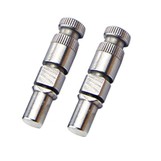
Hey there! As a motor shaft supplier, I often get asked about the thread specification on a motor shaft. So, I thought I'd write this blog to break it down for you.
First off, not all motor shafts have threads. Whether a motor shaft has a thread and what kind of thread it has depends on the motor's design and its intended use.
Let's start by understanding why a motor shaft might have a thread. One of the main reasons is for attaching other components. For example, if you want to attach a pulley, a gear, or a coupling to the motor shaft, a threaded end can make the connection much easier and more secure. You can simply screw on the component, and with the right torque, it'll stay firmly in place.
Now, when it comes to the types of threads, there are a few common ones. The most well - known is the Unified Thread Standard (UTS), which is widely used in North America. It includes two main types: UNC (Unified National Coarse) and UNF (Unified National Fine). UNC threads have a larger pitch, which means the distance between each thread is greater. They're great for applications where you need a quick and easy connection, or when the material you're threading into is a bit softer. On the other hand, UNF threads have a smaller pitch. They're more suitable for applications that require a finer adjustment or a more precise fit, like in some high - precision motors.
Another common thread standard is the Metric Thread Standard. This is used all over the world, especially in countries that follow the metric system. Metric threads are specified by their diameter and pitch, and they come in different classes for different levels of tolerance. For instance, a M8x1.25 thread means the diameter of the thread is 8mm, and the pitch (distance between threads) is 1.25mm.
The choice between UTS and Metric threads often depends on the geographical location of the motor's use and the industry standards. In the automotive industry in the US, you're more likely to see UTS threads, while in European or Asian manufacturing, metric threads are more prevalent.
If you're in the market for a motor shaft with specific thread specifications, we've got you covered. We offer a wide range of motor shafts, including DC Motor Shaft. DC motors are used in a variety of applications, from small electronic devices to large industrial machinery. Our DC motor shafts are made with high - quality materials and can be customized with the right thread specification for your needs.
We also have Motor Shaft SUS303 SUS304 SUS316. These shafts are made from stainless steel grades SUS303, SUS304, and SUS316, which offer different levels of corrosion resistance and strength. Depending on your application, you can choose the right grade and have it threaded according to your requirements.


For those working with AC motors, our AC Motor Shaft is a great option. AC motors are used in everything from household appliances to large - scale power generation. Our AC motor shafts are designed to meet the high - performance demands of these applications, and we can provide them with the appropriate thread specification.
When it comes to determining the thread specification for your motor shaft, there are a few things to consider. First, think about the component you'll be attaching to the shaft. Different components may require different thread sizes and types. You also need to consider the torque requirements. If the component will be under a lot of stress or vibration, you'll need a thread that can handle that without coming loose.
It's also important to ensure that the thread is cut properly. A poorly cut thread can lead to a weak connection, which can cause the component to come off during operation, leading to potential damage or safety hazards. At our company, we use state - of - the - art machining equipment to ensure that the threads on our motor shafts are cut accurately and to the highest quality standards.
In addition to the type and size of the thread, you may also need to consider the thread depth. The depth of the thread affects how much of the component can be screwed onto the shaft. A deeper thread generally provides a stronger connection, but it also depends on the thickness of the component and the overall design of the motor.
If you're unsure about the thread specification for your motor shaft, don't worry. Our team of experts is here to help. We can work with you to understand your application and recommend the best thread specification for your needs. We can also provide samples for you to test and ensure that they meet your requirements.
So, if you're looking for high - quality motor shafts with the right thread specification, look no further. Whether you need a DC Motor Shaft, Motor Shaft SUS303 SUS304 SUS316, or an AC Motor Shaft, we've got the expertise and the products to meet your needs.
If you're interested in purchasing our motor shafts or have any questions about thread specifications, feel free to reach out to us. We're eager to start a conversation and help you find the perfect motor shaft for your application. Let's work together to get your project up and running smoothly!
References
- Machinery's Handbook, 31st Edition
- Unified Thread Standard Documentation
- Metric Thread Standard Guidelines