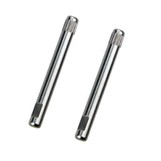
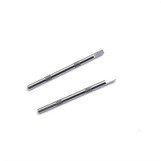
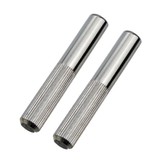
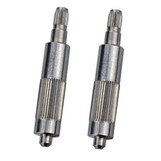
Stainless Steel Spindle Or Mandrel Shaft
Spindle Shaft
A spindle is the core rotating component of a mechanical system, primarily used to transmit power and achieve high-speed rotation. It is widely applied in machine tools, CNC equipment, and industrial robots, requiring high precision, strength, and durability.
Mandrel Shaft
A mandrel is mainly used to support or fix rotating components, suitable for winding materials (e.g., films, fibers) or positioning workpieces during processing. Its core function is to provide support and stability.
Advantages
Material Benefits:
● Corrosion Resistance: Contains chromium, forming a protective layer on the surface, suitable for humid or chemical environments.
● High Strength and Wear Resistance: Can withstand heavy loads and provide excellent service life.
● High-Temperature Resistance: Suitable for high-speed rotation or heat-intensive scenarios.
Common Stainless Steel Grades:
● 304: General-purpose stainless steel, suitable for standard environments.
● 316: High corrosion resistance, ideal for chemical or marine environments.
● 440C: High hardness and wear resistance, used for heavy-duty components.
● 17-4PH: Strengthened through heat treatment, suitable for high-temperature and high-strength applications.
Typical Applications
● CNC Machine Tools: Spindles for tool rotation and workpiece machining.
● Industrial Robots: Critical components for motion control.
● Automation Equipment: Used in winding machines, packaging systems, etc.
● Automotive Manufacturing: Essential in lathes and drilling equipment.
● Aerospace: High-strength, high-precision applications.
● Medical Devices: Centrifuges, surgical tools, and other high-requirement scenarios.
Processing Plan
1. Preparation Before Processing
● Material Selection: Choose the appropriate stainless steel grade based on application requirements (e.g., 304, 316). Use cold-drawn bars or forged blanks.
● Blank Cutting: Use sawing or laser cutting to cut the material into the required length, leaving 1-2mm of machining allowance.
2. Processing Steps
Rough Machining
● Process: Use a CNC lathe for preliminary turning to remove excess material.
● Goal: Machine the outer diameter close to the design size, leaving 0.2-0.5mm allowance.
Heat Treatment (if applicable)
● Quenching and Tempering: Improve hardness and toughness (especially for 440C and 17-4PH stainless steel).
● Solution Treatment: Enhance corrosion resistance for 316 stainless steel.
Finish Machining
● Outer Diameter Grinding:
Use a centerless grinding machine to achieve the final outer diameter.
Accuracy: ±0.003mm; surface roughness Ra ≤ 0.4μm.
● Turning End Faces and Drilling Holes:
Machine both end faces and center holes or mounting holes, ensuring perpendicularity and dimensional accuracy.
Threading (if required): Use CNC equipment for internal thread machining to ensure precision.
Polishing and Surface Treatment
● Polishing: Improve surface smoothness and remove minor defects to achieve a mirror finish.
● Electroplating/Passivation (Optional): Enhance corrosion resistance and wear resistance.
Quality Control
1.Dimensional Inspection:
● Use a high-precision micrometer or coordinate measuring machine (CMM) to check dimensions and geometric tolerances.
2.Surface Roughness Inspection:
● Ensure surface quality meets design requirements using a roughness tester.
3.Hardness Testing:
● Verify material hardness with a Rockwell or Vickers hardness tester.
4.Dynamic Balance Testing:
● Perform balance tests on high-speed rotating shafts to ensure operational stability.
Post-Processing and Packaging
1.Marking: Use laser engraving on the shaft surface to mark product specifications and batch numbers.
2.Rust Prevention: Apply anti-rust oil or wrap with anti-rust paper.
3.Packaging: Individually protect with plastic tubes, then place in wooden or cardboard boxes for protection. Use pallets for bulk transportation.
Example Processing Workflow
For a 304 stainless steel precision spindle shaft (diameter Φ20mm, length 300mm):
1.Material Selection: Use 304 cold-drawn stainless steel round bars.
2.Blank Cutting: Saw to a length of 302mm (2mm machining allowance).
3.Rough Machining: Turn the outer diameter to Φ19.6mm on a CNC lathe.
4.Heat Treatment: Perform solution treatment to enhance corrosion resistance and strength.
5.Finish Machining:
Centerless grinding to Φ19.5mm with surface roughness Ra ≤ 0.4μm.
Turn end faces and drill center holes Φ6mm.
6.Polishing: Achieve a mirror finish with surface roughness Ra ≤ 0.2μm.
7.Quality Control: Inspect dimensions, tolerances, and surface quality.
8.Packaging: Apply rust prevention and pack for shipment.


Hot Tags: stainless steel spindle or mandrel shaft, China stainless steel spindle or mandrel shaft manufacturers, suppliers, factory, Electric Toothbrush Drive Shaft, Drone Pitch Shaft, other shaft, Brushless Motor Shaft, rotating shaft, solid shaft