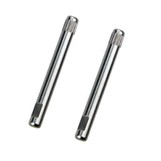
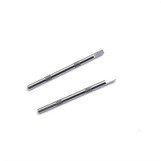
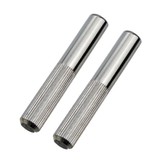
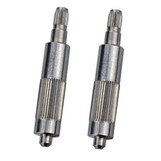
Precision Spindle Or Mandrel
Definition
Precision Spindle
A precision spindle refers to a rotating shaft that supports and guides tools, workpieces, or other rotating elements in mechanical systems. It is often powered by a motor and is designed to operate with minimal runout (rotational deviation), high rigidity, and excellent speed control.
Example: The spindle in a CNC machine that holds and rotates a cutting tool.
Precision Mandrel
A precision mandrel is a cylindrical rod or bar designed to support or secure a workpiece during machining, inspection, or testing. It provides an accurate reference surface or axis for operations requiring precise alignment.
Example: A mandrel used to hold a hollow workpiece for machining its outer surface.
While the spindle is often powered and rotates actively, the mandrel is usually stationary or supported by external forces, depending on the application.
Key Features
Both spindles and mandrels share certain core characteristics that make them critical for precision applications:
High Dimensional Accuracy
Manufactured with tight tolerances (often within microns) to ensure precise alignment and operation.
Straightness and roundness are critical to their performance.
Minimal Runout
Precision spindles and mandrels are designed to minimize radial and axial runout, ensuring smooth and accurate operation.
Typical runout values are in the range of 0.001mm - 0.005mm.
Material Strength and Hardness
Made from high-grade materials such as hardened steel, tungsten carbide, or stainless steel to resist wear, deformation, and vibration.
Surface hardness can reach HRC60-70 or higher.
Surface Finish
High-quality surface finish (e.g., roughness below Ra 0.2μm) ensures smooth contact and reduces wear between components.
Balancing and Stability
For rotating spindles, dynamic balancing is critical to prevent vibrations at high speeds, ensuring consistent performance.
Customizability
Available in various lengths, diameters, and configurations to suit specific applications (e.g., taper mandrels, collet spindles).
Types of Precision Spindles and Mandrels
1. Precision Spindles
Machine Tool Spindles
Found in CNC machines, milling machines, lathes, and grinding machines.
Holds and rotates tools (e.g., drills, cutters) with extreme precision.
High-Speed Spindles
Designed for applications requiring very high rotational speeds, such as in aerospace or micro-machining industries.
Uses advanced bearings (e.g., ceramic or magnetic bearings) to achieve low friction and high durability.
Rotary Spindles
Used in measuring devices or rotary tables to provide smooth and precise rotational motion.
2. Precision Mandrels
Expanding Mandrels
Designed to grip the internal diameter of hollow workpieces by expanding their outer surface.
Useful for machining or inspection where internal concentricity is required.
Taper Mandrels
Features a tapered surface for securely holding workpieces by friction or force-fitting.
Common in turning or grinding applications.
Step Mandrels
Include multiple diameter steps for holding workpieces with varying inner diameters.
Custom Mandrels
Tailored for specialized applications, such as in turbine blade balancing or complex inspection setups.
Applications
1. Precision Spindles
CNC Machining
Spindles are the core component of CNC machines, enabling precise tool rotation for milling, drilling, and grinding.
High-speed spindles are used for micro-machining or engraving.
Robotics
Used in robotic arms for high-speed rotational tasks, such as polishing or assembly.
Precision Measuring Equipment
Rotary spindles provide accurate positioning for metrology tools and calibration systems.
Aerospace and Defense
Employed in high-speed machining of turbine blades, precision drilling, and finishing.
2. Precision Mandrels
Machining Operations
Mandrels hold workpieces during turning, grinding, or milling operations to ensure concentricity and prevent movement.
Inspection and Calibration
Used as reference tools for checking the alignment and concentricity of components.
Balancing Systems
Mandrels are often used in balancing machines to support rotors, turbines, or fans during dynamic balancing processes.
Metalworking and Tube Manufacturing
Used to maintain the internal shape and dimensions of tubes or pipes during bending or welding processes.
Selection Criteria
Application Requirements
Determine if the component will be used for holding tools, workpieces, or metrology tasks.
Tolerances
Ensure the spindle or mandrel meets the required dimensional accuracy and runout specifications.
Material and Hardness
Select materials suitable for the operating environment (e.g., corrosion resistance for wet conditions, hardened steel for wear resistance).
Rotational Speed (for Spindles)
Ensure the spindle is rated for the desired speed range without excessive heat or vibration.
Load Capacity
Consider the maximum radial and axial loads the component will need to withstand.
Mounting Compatibility
Verify that the spindle or mandrel is compatible with the equipment's mounting system (e.g., collets, chucks, or adapters).
Dynamic Balancing (for Spindles)
Ensure the spindle is dynamically balanced to minimize vibration at high speeds.
Maintenance and Care
Lubrication:Regularly lubricate bearings or sliding surfaces to reduce friction and wear.
Inspection:Periodically check for runout, wear, and alignment to maintain precision.
Cleaning:Keep surfaces clean and free from debris, which can impact accuracy and performance.
Proper StorageStore mandrels and spindles in protective cases to prevent damage when not in use.


Hot Tags: precision spindle or mandrel, China precision spindle or mandrel manufacturers, suppliers, factory, Robot Main Shaft, rotating shaft, hard chrome shaft, Precision Mini Shaft, eccentric shaft, Precision Spindle Or Mandrel