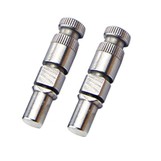
As a fixed shaft supplier, I often encounter questions from customers about various technical aspects of fixed shafts. One of the most frequently asked questions is how to measure the damping ratio of a fixed shaft. In this blog post, I'll share some insights and methods on this topic.


Understanding the Damping Ratio of a Fixed Shaft
Before diving into the measurement methods, it's essential to understand what the damping ratio means in the context of a fixed shaft. The damping ratio is a dimensionless measure that describes how oscillations in a system decay after a disturbance. In the case of a fixed shaft, it reflects the shaft's ability to dissipate energy when it vibrates. A higher damping ratio indicates that the shaft can reduce vibrations more effectively, which is crucial for applications where precision and stability are required.
Why Measuring the Damping Ratio is Important
Measuring the damping ratio of a fixed shaft is vital for several reasons. Firstly, it helps in evaluating the dynamic performance of the shaft. In high - speed machinery, excessive vibrations can lead to premature wear and tear, reduced accuracy, and even catastrophic failures. By knowing the damping ratio, engineers can design systems that are more reliable and efficient. Secondly, it allows for the optimization of the shaft design. If the damping ratio is too low, design modifications can be made to increase the energy - dissipation capacity of the shaft.
Methods for Measuring the Damping Ratio of a Fixed Shaft
1. Free Vibration Decay Method
The free vibration decay method is one of the simplest and most commonly used techniques for measuring the damping ratio. Here's how it works:
- Excitation: First, the fixed shaft needs to be excited to start vibrating. This can be done by applying a sudden impact, such as hitting the shaft with a hammer. The impact imparts an initial energy to the shaft, causing it to vibrate freely.
- Measurement: As the shaft vibrates, the amplitude of the vibration gradually decreases over time due to damping. A vibration sensor, such as an accelerometer, is attached to the shaft to measure the vibration amplitude as a function of time.
- Calculation: The damping ratio can be calculated from the decay of the vibration amplitude. For a lightly damped system, the relationship between the amplitudes of two consecutive peaks (A_n) and (A_{n + 1}) in the vibration signal is given by the logarithmic decrement (\delta):
(\delta=\ln\left(\frac{A_n}{A_{n + 1}}\right))
The damping ratio (\zeta) can then be calculated using the formula (\zeta=\frac{\delta}{2\pi}) for small damping ((\zeta\ll1)).
2. Frequency Response Function (FRF) Method
The Frequency Response Function method is more sophisticated and provides more detailed information about the dynamic behavior of the fixed shaft.
- Excitation: A sinusoidal force is applied to the shaft over a range of frequencies. This can be achieved using a shaker or a piezoelectric actuator.
- Measurement: The response of the shaft, typically measured as the acceleration or displacement, is recorded at the same time. The ratio of the response amplitude to the excitation force amplitude at each frequency is calculated to obtain the FRF.
- Calculation: The damping ratio can be determined from the shape of the FRF curve. For a single - degree - of - freedom system, the damping ratio (\zeta) can be calculated from the half - power bandwidth (\Delta f) of the resonance peak in the FRF curve. The formula is (\zeta=\frac{\Delta f}{2f_n}), where (f_n) is the natural frequency of the shaft.
3. Modal Analysis Method
Modal analysis is a comprehensive approach that can be used to measure the damping ratio of a fixed shaft, especially for complex systems.
- Excitation and Measurement: Similar to the FRF method, the shaft is excited with a multi - frequency input, and the response is measured at multiple points on the shaft. This provides a set of data that can be used to identify the different vibration modes of the shaft.
- Modal Parameter Identification: Advanced algorithms are used to extract the modal parameters, including the natural frequencies, mode shapes, and damping ratios, from the measured data. This method can accurately identify the damping characteristics of each vibration mode of the shaft.
Factors Affecting the Damping Ratio of a Fixed Shaft
Several factors can affect the damping ratio of a fixed shaft:
- Material Properties: Different materials have different damping capacities. For example, materials with high internal friction, such as some polymers, tend to have higher damping ratios compared to metals. As a supplier, we offer Stainless Steel Fixed Shaft and Precision Fixed Shaft made from various materials, each with its own damping characteristics.
- Shaft Geometry: The shape and size of the shaft can also influence the damping ratio. For instance, a shaft with a larger cross - sectional area may have a different damping behavior compared to a thinner shaft.
- Boundary Conditions: The way the shaft is supported or fixed at its ends can significantly affect the damping ratio. Different boundary conditions, such as fixed - fixed, fixed - free, or simply supported, can lead to different vibration modes and damping characteristics.
Importance of Accurate Damping Ratio Measurement for Our Customers
For our customers, accurate measurement of the damping ratio is crucial for ensuring the proper functioning of their machinery. Whether it's in the automotive industry, aerospace, or precision manufacturing, the performance of the equipment depends on the dynamic behavior of the fixed shafts. By providing high - quality fixed shafts and sharing our knowledge on damping ratio measurement, we can help our customers optimize their designs and improve the reliability of their products.
Conclusion
Measuring the damping ratio of a fixed shaft is an important aspect of understanding its dynamic performance. There are several methods available, each with its own advantages and limitations. As a fixed shaft supplier, we are committed to providing our customers with not only high - quality products but also the technical support they need. If you are interested in our Stainless Steel Fixed Shaft or Precision Fixed Shaft, or if you have any questions about damping ratio measurement or other technical aspects, please feel free to contact us for further discussion and potential procurement.
References
- Meirovitch, L. (1986). Elements of Vibration Analysis. McGraw - Hill.
- Inman, D. J. (2014). Engineering Vibration. Pearson.