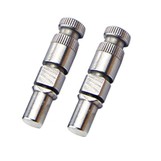
Hey there! As a long shaft supplier, I've been dealing with all sorts of long shafts for years. One of the most important aspects in the world of long shafts is dynamic balancing. In this blog, I'm gonna share with you the dynamic balancing methods for a long shaft.
First off, let's understand why dynamic balancing is so crucial for long shafts. A long shaft is often used in high - speed rotating machinery, like motors, turbines, and some industrial equipment. When a shaft rotates, any imbalance can cause a whole bunch of problems. It can lead to excessive vibration, which not only shortens the lifespan of the shaft itself but also the connected components. Vibration can also generate noise, and in extreme cases, it may even cause the machinery to malfunction or break down. So, getting that dynamic balance right is a must - do.
1. Single - Plane Balancing
The single - plane balancing method is relatively simple and is suitable for some less - demanding long shaft applications. In this method, we assume that the imbalance of the long shaft is concentrated in one plane.
We start by mounting the long shaft on a balancing machine. The balancing machine can detect the vibration caused by the imbalance. Once the machine has measured the amount and position of the imbalance, we can correct it. There are two common ways to do this. One is by adding weights. We can attach small weights at the appropriate position on the shaft to counteract the imbalance. The other way is by removing material. For example, we can use a milling machine to carefully remove a small amount of material from the heavy side of the shaft.
However, single - plane balancing has its limitations. In reality, long shafts often have imbalances distributed along their length, not just in one plane. So, this method may not be sufficient for shafts that require high - precision balancing.
2. Two - Plane Balancing
When the single - plane balancing isn't enough, we turn to the two - plane balancing method. This approach takes into account the fact that the imbalance of a long shaft can occur in two different planes along its length.
The process of two - plane balancing is a bit more complex. First, we need to identify two reference planes on the long shaft. These planes are usually chosen based on the design and structure of the shaft. Then, we use a more advanced balancing machine that can measure the imbalance in both of these planes simultaneously.
After measuring the imbalances in the two planes, we again have the options of adding or removing weights. The key is to adjust the weights in both planes in a coordinated way to achieve overall balance. This method provides a much more accurate balance compared to single - plane balancing and is widely used in many industrial applications. For instance, in the manufacturing of Stainless Steel Long Shaft, which are often used in high - speed and high - precision equipment, two - plane balancing is often required to ensure smooth operation.
3. Multi - Plane Balancing
For long shafts with extremely high - precision requirements, multi - plane balancing is the way to go. In some complex machinery, the imbalance of a long shaft can be distributed in multiple planes along its length.
Multi - plane balancing involves dividing the long shaft into several planes and measuring and correcting the imbalances in each of these planes. This requires very sophisticated balancing equipment and highly skilled technicians. The process is time - consuming and expensive, but it can achieve the highest level of balance.
The balancing machine used for multi - plane balancing is equipped with advanced sensors and algorithms. These sensors can accurately measure the vibration and imbalance in each plane, and the algorithms can calculate the optimal way to correct the imbalances. After the measurements, we can add or remove weights in each plane as needed. This method is commonly used in aerospace and high - end automotive applications, where the performance and reliability of the equipment are of utmost importance.
4. Influence Coefficient Method
The influence coefficient method is a mathematical approach to dynamic balancing. This method is based on the principle that the vibration response of a long shaft to an added weight at a certain position can be measured and used to calculate the imbalance.
First, we perform a series of test runs. In each run, we add a known weight at a specific position on the shaft and measure the resulting vibration. By repeating this process at different positions, we can obtain a set of data. Then, using mathematical calculations, we can determine the influence coefficients, which describe how the vibration of the shaft changes with the addition of weights at different positions.


Once we have the influence coefficients, we can use them to calculate the amount and position of the weights needed to balance the shaft. This method is very accurate and can be applied to both single - plane and multi - plane balancing. It's especially useful when dealing with shafts that have complex geometries or when the traditional balancing methods are not effective.
5. Modal Balancing
Modal balancing is another advanced method for long shaft balancing. This approach is based on the vibration modes of the shaft. Every long shaft has its own natural vibration modes, which are determined by its material, geometry, and support conditions.
In modal balancing, we first need to measure the vibration modes of the long shaft using techniques such as laser vibrometry. Then, we analyze the contribution of each vibration mode to the overall imbalance. By focusing on the dominant vibration modes, we can determine the most effective way to balance the shaft.
We can adjust the balance by adding or removing weights at specific positions that have the greatest influence on the dominant vibration modes. Modal balancing is particularly useful for long shafts that operate at high speeds, as it can effectively reduce the vibration caused by the resonance of the shaft's natural modes.
If you're in the market for high - quality long shafts, whether it's a Stainless Steel Long Shaft or a Precision Long Shaft, we've got you covered. We use the latest dynamic balancing methods to ensure that our shafts meet the highest standards of quality and performance.
If you have any questions about our long shafts or need more information on dynamic balancing, don't hesitate to reach out. We're always happy to have a chat and discuss your specific requirements. Whether you're a small - scale manufacturer or a large industrial enterprise, we can work together to find the perfect long shaft solution for you. Let's start a conversation about your procurement needs and see how we can help you take your machinery to the next level.
References
- Rothberg, J. E. (2001). Balancing of Rotating Machinery. Marcel Dekker.
- Vance, J. M. (1988). Rotordynamics of Turbomachinery. Wiley.
- Goodman, J. F. (1988). Vibration and Shock Handbook. McGraw - Hill.