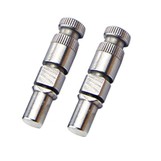
Hey there! As a supplier of linear shafts, I often get asked about the bending resistance of these little powerhouses. So, let's dive right in and explore what bending resistance in a linear shaft is all about.


First off, what the heck is a linear shaft? Well, it's a cylindrical rod that's designed to provide linear motion. You'll find these shafts in all sorts of applications, from industrial machinery to 3D printers. Think of it as a track for other components to slide along. Its straight and smooth surface allows devices like bearings to move back and forth with ease.
Now, let's talk about bending resistance. Simply put, it's the ability of a linear shaft to withstand forces that try to bend it. When we're dealing with linear motion applications, a shaft that bends can cause all sorts of headaches. For example, it might lead to inaccurate positioning, increased friction, and even premature wear and tear on the parts that interact with the shaft.
There are a bunch of factors that affect the bending resistance of a linear shaft. The first one is the material. Just like you'd expect different types of wood or metal to have different strengths, linear shafts made from different materials vary in their ability to resist bending.
Hardened Steel Linear Shaft is a popular choice. As the name suggests, this type of shaft is made from hardened steel. The heat treatment process that steel goes through to get hardened makes it incredibly strong. The carbon atoms in the steel are rearranged in a way that gives it a tight and strong molecular structure. This means that it can take a lot of force before it starts to bend. It's like giving the shaft a super - armor. Hardened steel linear shafts are often used in heavy - duty applications where there are high loads and forces at play.
On the other hand, we have Precision Linear Shaft. These shafts are all about accuracy. They're typically made from high - quality materials that can maintain their shape precisely. The machining process used to create them is extremely precise, which ensures that the shaft has a very uniform cross - section. A uniform cross - section is crucial for good bending resistance. If there are any weak spots or inconsistencies in the shaft, it's more likely to bend when a force is applied.
Another factor is the diameter of the shaft. You can think of it like this: if you have two poles of the same material, but one is thicker than the other, the thicker pole is going to be harder to bend. The same principle applies to linear shafts. A shaft with a larger diameter has more material to distribute the bending force across. This means that it can withstand greater forces without bending. However, bigger isn't always better. A larger diameter shaft might be heavier, which could be a problem in applications where weight is a concern, like in some aerospace or mobile machinery applications.
The length of the shaft also plays a role. The longer the shaft, the more likely it is to bend under a given force. This is because the force has more distance to act on. It's similar to trying to hold a long stick straight. The longer the stick, the harder it is to keep it from bending. In situations where you need a long shaft, you might need to take extra measures to improve its bending resistance, like adding support structures or using a stronger material.
Surface finish can also impact bending resistance. A smooth surface finish on a linear shaft is not just for aesthetics. It helps to reduce stress concentrations. When a shaft has a rough surface, there are tiny peaks and valleys. These can act as points where stress builds up when a force is applied, making the shaft more prone to bending. A well - finished shaft distributes the stress more evenly, which in turn improves its ability to resist bending.
To measure the bending resistance of a linear shaft, engineers often use complex formulas based on the principles of beam theory. These formulas take into account the material properties, the dimensions of the shaft, and the type of loading (whether it's a point load or a distributed load). By using these calculations, they can predict how much force a shaft can handle before it starts to deform.
In real - world testing, we subject the shaft to controlled loads. We use specialized equipment to apply a force to the shaft and then measure how much it deflects. The amount of deflection gives us an idea of its bending resistance. The less the shaft bends under a given load, the better its bending resistance.
So, why does all this matter? Well, if you're in the market for linear shafts, understanding bending resistance can help you choose the right shaft for your application. If you have a high - load application, like a large - scale conveyor system or a heavy - duty press, you're going to need a shaft with excellent bending resistance. Hardened steel linear shafts might be your best bet.
On the other hand, if you're working on a precision application, like a laboratory instrument or a high - end 3D printer, a precision linear shaft would be more appropriate. These shafts can provide the right balance between accuracy and the ability to withstand the forces exerted on them during normal operation.
If you're intrigued by what I've talked about and think that our linear shafts could be the right fit for your project, I encourage you to get in touch. Whether you need more information about the bending resistance of our products, want to discuss your specific application requirements, or are ready to start a purchase, we're here to help. Our team of experts can guide you through the selection process and ensure that you get the best linear shaft for your needs.
References
- Mechanics of Materials textbooks
- Industry - specific research papers on linear motion components