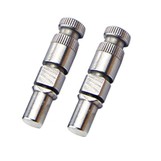
Hey there! As a supplier of fixed shafts, I often get asked about the load - bearing capacity of these crucial components. So, I thought I'd take some time to break it down for you all in this blog.
Let's start with the basics. A fixed shaft is a mechanical part that's designed to support rotating elements like gears, pulleys, or wheels. It's fixed in place, hence the name, and doesn't move axially. The load - bearing capacity of a fixed shaft is the maximum amount of load it can handle without experiencing excessive deformation, failure, or damage.
There are several factors that can affect the load - bearing capacity of a fixed shaft. First up is the material. Different materials have different strength properties. For example, stainless steel is known for its high corrosion resistance and good strength. Check out our Stainless Steel Fixed Shaft for a product that combines these great features. Stainless steel can handle quite a bit of load, especially in harsh environments where corrosion could be an issue.
On the other hand, if you need a shaft with extremely precise dimensions and high - quality performance, our Precision Fixed Shaft is a great option. The material used in precision shafts is carefully selected to ensure not only high strength but also the ability to maintain accuracy under load.
The diameter of the shaft is another important factor. Generally speaking, a thicker shaft can bear more load than a thinner one. This is because a larger cross - sectional area provides more material to resist the forces acting on the shaft. When a load is applied, the stress is distributed over the cross - section of the shaft. A larger area means less stress per unit area, which allows the shaft to handle more load without failing.
The length of the shaft also plays a role. A longer shaft is more likely to bend under load compared to a shorter one. This is due to the increased leverage that the load has on the shaft. So, if you have a long - shaft application, you might need to consider a shaft with a larger diameter or use additional supports to increase its load - bearing capacity.
The type of load is crucial too. There are different types of loads that a fixed shaft can experience, such as axial loads, radial loads, and torsional loads. Axial loads act along the axis of the shaft, like when a shaft is being pushed or pulled in a straight line. Radial loads act perpendicular to the axis of the shaft, for example, when a gear is mounted on the shaft and exerts a force on it. Torsional loads are caused by twisting forces, like when the shaft is used to transmit torque.
Let's take a closer look at how to calculate the load - bearing capacity. There are several engineering formulas and standards that can be used. For simple cases, we can use basic mechanics principles. For example, the stress in a shaft under a radial load can be calculated using the formula $\sigma=\frac{M y}{I}$, where $\sigma$ is the stress, $M$ is the bending moment, $y$ is the distance from the neutral axis to the outer fiber of the shaft, and $I$ is the moment of inertia of the cross - section.
If the stress calculated is less than the allowable stress of the material, then the shaft can safely bear the load. The allowable stress is determined by the material properties and is usually provided by material suppliers or can be found in engineering handbooks.
In real - world applications, we also need to consider factors like fatigue. Fatigue occurs when a shaft is subjected to repeated loading and unloading cycles. Over time, even if the load is below the static load - bearing capacity of the shaft, it can still cause cracks to form and eventually lead to failure. To account for fatigue, we often use a fatigue factor of safety, which is a multiplier applied to the calculated load - bearing capacity to ensure the shaft will last for a long time under cyclic loading.
Another important aspect is the surface finish of the shaft. A smooth surface finish can reduce stress concentrations. Stress concentrations occur at points where there are sudden changes in the geometry of the shaft, like at keyways or shoulders. These areas can experience much higher stress than the rest of the shaft, which can lead to premature failure. By having a smooth surface finish, we can distribute the stress more evenly and increase the load - bearing capacity.
Now, let's talk about how we, as a fixed - shaft supplier, ensure the high load - bearing capacity of our products. We start by using high - quality materials. We source our materials from trusted suppliers and conduct strict quality control checks. We also use advanced manufacturing processes, such as CNC machining, to ensure the precise dimensions and excellent surface finish of our shafts.
Our engineers have years of experience in designing and manufacturing fixed shafts. They use the latest engineering software to analyze the stress and deformation of the shafts under different loads. This allows us to optimize the design of the shafts and ensure they meet or exceed the required load - bearing capacity.
In addition, we offer customization services. Every application is different, and we understand that you might have specific requirements for the load - bearing capacity, dimensions, or material of the fixed shaft. Our team can work with you to design and manufacture a custom - made fixed shaft that exactly meets your needs.
If you're in the market for a fixed shaft and want to learn more about the load - bearing capacity or need a shaft for your specific application, don't hesitate to reach out to us. We're here to help you find the best solution for your project. Whether you need a Stainless Steel Fixed Shaft for a corrosive environment or a Precision Fixed Shaft for a high - precision application, we've got you covered.
Let's work together to ensure your machinery runs smoothly and efficiently with our high - quality fixed shafts. Contact us today to start the procurement process and discuss your requirements.


References
- Mechanical Engineering Design, Shigley's
- Materials Science and Engineering: An Introduction, Callister and Rethwisch